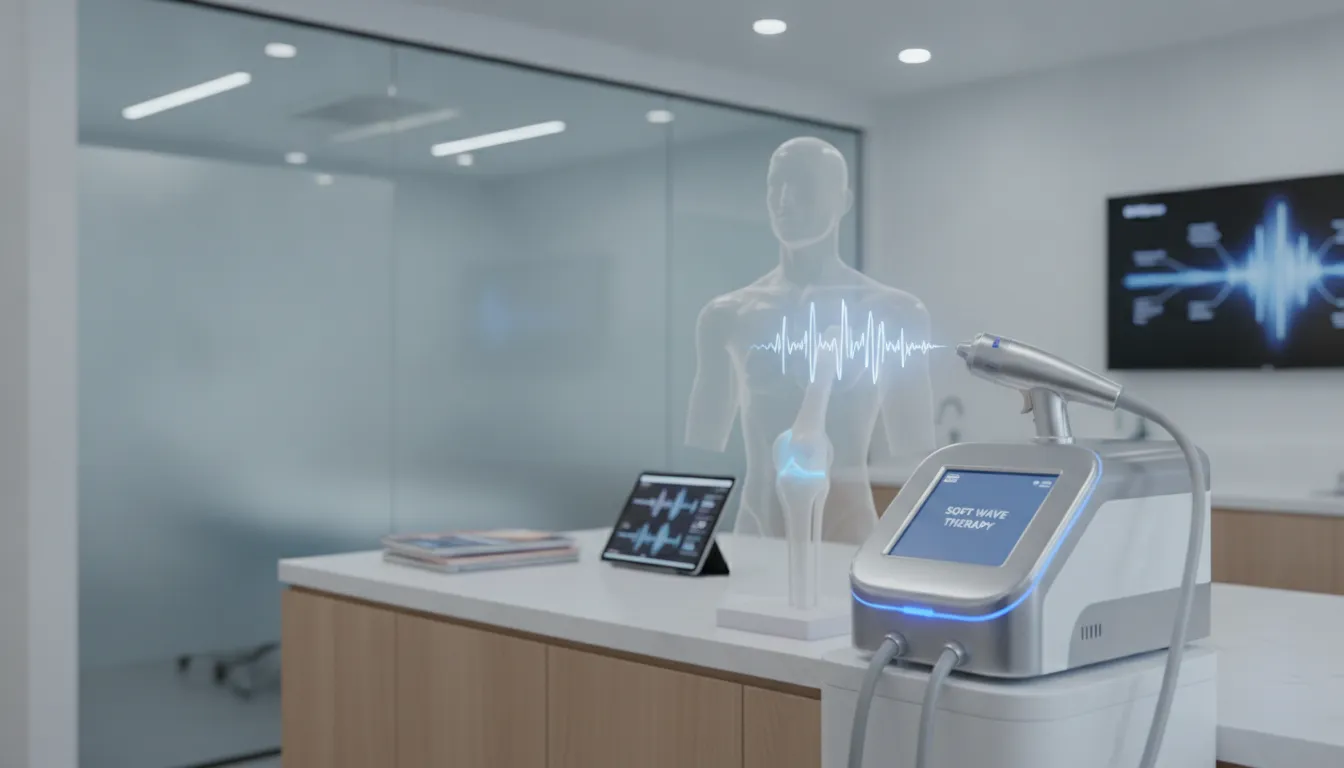
Physical therapy continues to move toward biologically driven rehabilitation, with regenerative technologies increasingly integrated into outpatient settings. Shockwave physical therapy has gained traction across orthopedic rehabilitation, sports medicine, and musculoskeletal care because it stimulates tissue healing through high-energy mechanical pulses, without injections, surgery, or extended downtime. For physical therapists managing chronic tendinopathies, post-surgical recovery, and overuse injuries, it offers a regenerative modality that fits naturally alongside movement-based care.
How Shockwave Therapy Works in a Physical Therapy Setting
A shockwave is a high-amplitude, supersonic pressure pulse with an extremely rapid rise time and a single-cycle waveform. It is generated electrohydraulically, electromagnetically, or piezoelectrically, and it travels through tissue as a discrete pressure discontinuity rather than as a continuous sound wave. That physical profile is what allows extracorporeal shockwave therapy (ESWT) to penetrate deep musculoskeletal structures and trigger a biologic healing response, rather than just creating surface vibration.
The biologic mechanism is mechanotransduction, where mechanical energy is converted into intracellular signaling activity that influences blood flow, inflammatory regulation, collagen remodeling, and connective tissue response. Several regenerative effects follow. Angiogenesis improves vascularization and supports recovery in chronically inflamed or poorly perfused structures. Progenitor cell recruitment and growth factor release contribute to tissue regeneration, particularly in chronic tendinopathies where intrinsic healing capacity has diminished.
Clinical Evidence for ESWT in Physical Therapy
Shockwave therapy is most commonly applied to chronic soft tissue conditions that have not responded adequately to exercise, manual therapy, or conventional modalities alone, with growing application in acute sports rehab and post-operative recovery. The clinical evidence base spans systematic reviews, meta-analyses, and society-level recognition.
A few studies illustrate where the evidence stands for PT-relevant applications:
- Indications in physical medicine and rehabilitation. A PM&R-specific review catalogs ISMST-approved standard indications including calcifying tendinopathy of the shoulder, plantar fasciitis, lateral epicondylopathy, greater trochanteric pain syndrome, patellar tendinopathy, Achilles tendinopathy, and bone non-union, alongside emerging applications such as myofascial trapezius syndrome, low back pain, and nerve regeneration (Keilani & Crevenna, 2021).
- Structural change confirmed on imaging. A 2020 systematic review and meta-analysis evaluating imaging-based outcomes across multiple musculoskeletal conditions found that shockwave therapy produced measurable structural changes in affected tissues, supporting its role as a regenerative intervention rather than a symptomatic one (Al-Abbad et al., 2020).
- Sports injuries and active populations. A 2024 systematic review in British Journal of Sports Medicine concluded that ESWT may offer effective treatment alone or as an adjunct to concurrent exercise therapy across selected sports-related injuries in athletes and physically active individuals, without major adverse events (Rhim et al., 2024).
- Breadth of musculoskeletal applications. A foundational review documents ESWT’s role across over-use tendinopathies, non-union fractures, and chronic soft tissue conditions, with reported success rates of 65 to 91 percent and a low complication profile (Wang, 2012).
Why SoftWave Fits the Physical Therapy Workflow
Among true shockwave systems, SoftWave is the only broad-focused electrohydraulic device on the market. Focused shockwave systems concentrate energy into a narrow focal point, which works for pinpoint targets but requires repeated repositioning across a treatment area. SoftWave Gold Li Series has a patented parabolic reflector distributes plasma-driven shockwaves across a wider and deeper therapeutic field, allowing physical therapists to address larger anatomical regions, such as a full plantar fascia, an Achilles tendon with surrounding paratenon, or a broad myofascial trigger area, with fewer treatment passes.
Several design features map directly onto what physical therapy practices need from a regenerative modality:
- Broad-focused energy field. A wider treatment volume per pulse means fewer shocks per session and fewer total sessions per patient, with better tolerability than narrow focal devices.
- Anabolic energy delivery. Energy sits at or below 0.18 mJ/mm², avoiding the catabolic range above 0.22 mJ/mm² associated with cellular damage in tissue you’re trying to heal.
- Multiple FDA Class II clearances. Cleared indications relevant to PT case mix include improvement in local blood circulation, activation of connective tissue, relief of minor muscle aches and pains, and treatment of chronic diabetic foot ulcers and second-degree burns.
- ISMST recognition. The device is recognized by the International Society for Medical Shockwave Treatment, which supports its standing within the broader evidence-based shockwave category.
- Adoption by leading institutions and pro teams. SoftWave is in use at Mayo Clinic, Cleveland Clinic, and Hospital for Special Surgery, alongside teams across the NFL, NBA, MLB, NHL, MLS, PGA, NCAA, Premier League, and UFC.
In practice, a SoftWave session fits inside a standard outpatient appointment, typically 10 to 15 minutes, with no injections or anesthesia required. Once a treatment plan is established, the therapy can be delegated to a trained PT assistant, which preserves provider time for evaluation and progression decisions.
The Role of Shockwave in Modern Rehabilitation
Rehabilitation is moving toward biologically driven care, with patient demand shifting toward non-invasive, non-opioid options that activate regenerative biology rather than mask pain. For physical therapists, the question is no longer whether shockwave belongs in a PT setting, but which device actually delivers what the category promises. SoftWave’s combination of true broad-focused electrohydraulic delivery, multiple FDA clearances, and adoption by leading institutions and pro teams positions it as the system to evaluate when shockwave physical therapy becomes a serious capital decision for your practice.
Become a Provider or Schedule a Demo to learn how SoftWave fits your physical therapy practice.
Frequently Asked Questions
Is shockwave physical therapy the same as ultrasound therapy?
No. Ultrasound therapy uses continuous low-energy sound waves for tissue heating and mild biologic effect. Shockwave therapy uses a discrete supersonic pressure pulse to trigger mechanotransduction, angiogenesis, and tissue regeneration. The therapeutic mechanisms and clinical applications are distinct.
How many shockwave sessions does a typical PT patient need?
Treatment protocols vary by condition and severity. Most musculoskeletal cases respond to a weekly series of 3 to 6 sessions integrated alongside an active rehabilitation program. Broad-focused devices generally require fewer total sessions than narrow focal or radial systems because each pulse covers a larger tissue volume.
Can physical therapists deliver shockwave therapy themselves?
Yes, where state scope of practice permits. Shockwave therapy is delivered by PTs and PT assistants in most outpatient settings. The procedure does not require injections or anesthesia, and operational training is typically completed in a single onboarding session.
Does shockwave therapy replace exercise-based rehabilitation?
No. Shockwave therapy is an adjunct, not a replacement. The biologic response it triggers improves the tissue environment for healing, but functional recovery still depends on loaded exercise progression, mobility work, and neuromuscular re-education.
Is shockwave physical therapy covered by insurance?
Coverage varies by payer and indication. Most shockwave therapy in PT settings is delivered on a cash-pay basis, though some payers have begun extending coverage for specific conditions such as chronic plantar fasciitis. The SoftWave reimbursement resource covers current coding and payer status.