

SoftWave Therapy employs a patented parabolic reflector that converts electrohydraulic shockwaves into a broadly focused energy field.
This configuration produces a defined therapeutic volume (fz −6 dB = 0–82 mm) designed for consistent energy distribution across both superficial and deeper tissues.
The following specifications describe the operational and geometric parameters of the OP155 applicator, which forms the core of the SoftWave therapy system.
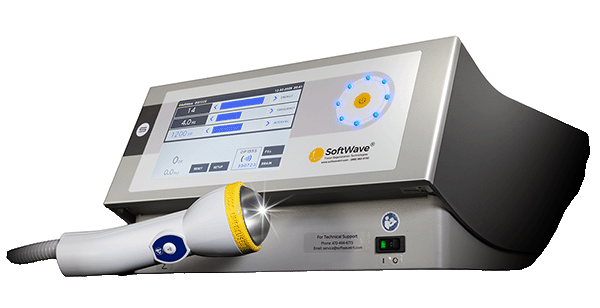
| Parameter | Specification |
|---|---|
| Applicator Model | OP155 |
| Therapeutic Focus (fz -6dB) | 0 – 82 mm |
| Energy Flux Density (ED) | 0.01 – 0.19 mJ/mm² |
| Focus Energy (-6dB) | 0.34 – 4.22 mJ |
| Repetition Rate | 0.5 – 8 Hz |
| Power Input | 200 VA |
| Power Supply | AC 100 – 240 V, 50 – 60 Hz |
| Dimensions | 8.5 × 15.75 × 18 in (21.8 × 40 × 45.9 cm) |
| Weight | 36.3 lbs (16.5 kg) |
|
Compared with narrow-point focused or radial systems, the SoftWave field covers a larger treatment volume, reducing repositioning during sessions. |
SoftWave therapy is FDA-cleared for activation of connective tissue and improved blood circulation and is used by clinicians in musculoskeletal and soft-tissue pain protocols.
SoftWave TRT holds multiple FDA 510(k) clearances for:
SoftWave devices also carry Health Canada and CE Mark recognition across several specialties, confirming compliance with global safety and performance standards.
SoftWave therapy is a non-invasive technology. Typical experiences include transient, mild soreness in the treated area; outcomes vary based on condition, protocol, and patient response.
The OP155 delivers energy across a 0–82 mm focus depth, allowing treatment of both surface-level and deep musculoskeletal tissue.
SoftWave operates within an energy flux density (ED) range of 0.01–0.19 mJ/mm², allowing clinicians to adjust acoustic output according to tissue sensitivity, treatment area, and protocol requirements.
SoftWave uses a patented parabolic reflector to generate broad focused shockwaves, distributing energy over a larger therapeutic volume than narrow-point focused or radial systems. This design minimizes the need for constant repositioning and supports efficient, uniform treatment coverage.
SoftWave systems operate at 0.5 to 8 Hz, enabling clinicians to adjust the pulse frequency for patient comfort, treatment depth, and procedural efficiency.