Shockwave therapy for podiatrists is most useful when framed as a clinical tool for chronic heel pain, tendinopathy, diabetic wound care, and other foot and ankle conditions that do not respond well to standard conservative care.
SoftWave TRT and other ESWT systems are part of a broader move toward non-invasive regenerative treatment pathways. For podiatric practices, the clinical question is not whether shockwave therapy is available. The more practical question is which type of system fits the indication, treatment depth, patient profile, and clinic workflow.
What Shockwave Therapy Means in Podiatry
In podiatric medicine, shockwave therapy applies controlled mechanical energy to musculoskeletal, connective tissue, and wound structures. The goal is to stimulate biologic responses associated with angiogenesis, inflammatory modulation, cellular signaling, and tissue repair.
These mechanisms matter in the foot and ankle because plantar fascia, tendon insertions, neuropathic tissue, and diabetic wounds often face repetitive load, impaired perfusion, or delayed healing. Mechanistic research describes how ESWT can influence neovascularization, growth factor activity, and repair signaling.
Where Shockwave Therapy Fits in Foot and Ankle Care
Shockwave therapy is best positioned as an adjunct to podiatric treatment plans, not a replacement for diagnostic workup, biomechanics, offloading, wound management, or rehabilitation.
Plantar Fasciitis and Chronic Heel Pain
Plantar fasciitis is one of the most studied ESWT indications in podiatry. Fansa et al. (2021) reported significant pain and function improvement in patients with plantar fasciitis treated with the OrthoGold 100, with pain VAS improving from 6.7 to 2.6 after three weekly sessions and 81.5 percent patient satisfaction at final follow-up. For podiatrists, this supports ESWT as a non-invasive option for chronic heel pain that has not responded well to orthotics, stretching, footwear changes, activity modification, and other conservative measures.
Achilles Tendinopathy
Achilles tendinopathy is another common foot and ankle condition where ESWT may fit after conservative care has failed. Gerdesmeyer et al. (2015) reported efficacy signals for focused and radial ESWT in chronic Achilles tendinopathy. In practice, ESWT should be paired with tendon rehabilitation, load management, footwear assessment, and reassessment of insertional versus midportion involvement.
Sports Medicine and Active Patients
In podiatric sports medicine, ESWT may support treatment plans for active patients who want to limit downtime. Schroeder et al. (2021) reported ESWT use across plantar fasciopathy, Achilles tendinopathy, bone stress injuries, medial tibial stress syndrome, and other overuse injuries, while noting that protocols vary across studies. For podiatrists treating runners, athletes, and active adults, ESWT is most appropriate when paired with rehabilitation and return-to-activity planning.
Diabetic Foot Ulcers and Chronic Wounds
Diabetic foot ulcers and chronic wounds require a different pathway than heel pain or tendon care. Huang et al. (2020) found improved wound surface area reduction, re-epithelialization, and complete cure rates across randomized controlled trials involving diabetic foot ulcers, while Marcus (2020) and Ottomann et al. (2012) add broader wound-healing support through chronic wound and burn literature. For podiatrists, ESWT should be positioned as an adjunct to vascular assessment, glucose management, infection control, debridement when indicated, pressure relief, moisture balance, and multidisciplinary wound care.
Peripheral Neuropathy Symptoms
Shockwave therapy may support symptomatic care for selected podiatric patients with peripheral neuropathy, particularly when nerve-related pain overlaps with altered gait, reduced protective sensation, vascular compromise, or ulcer risk. Lohse-Busch et al. (2014) reported symptom improvement in a small pilot study of patients with distally symmetric polyneuropathy. Mariotto et al. (2005) supports a related anti-inflammatory mechanism through endothelial nitric oxide activity and reduced NF-κB activation. For podiatrists, shockwave therapy should remain an adjunct to diabetic management, skin surveillance, footwear, offloading, and risk reduction.
How Radial, Focused, and Broad-Focused Systems Differ
Shockwave therapy systems differ in wave generation, tissue depth, field size, and targeting requirements. This distinction helps podiatrists avoid treating ESWT as one uniform category.
| System | Best fit | Main clinical consideration |
|---|---|---|
| Radial systems | Surface level and diffuse tissue patterns, such as broad plantar fascia or myofascial applications | Energy is highest near the applicator and decreases with depth, so deep or highly localized pathology may need another approach |
| Focused systems | Defined anatomic targets that require depth and precision, such as insertional pathology or calcific tissue | Requires more localization and may increase setup time, but can concentrate energy at a chosen depth |
| Broad-focused electrohydraulic systems | Mixed superficial and deep tissue involvement across a wider foot or ankle treatment field | Designed to cover more tissue in fewer passes while preserving true shockwave delivery |
How Podiatrists Should Evaluate a Shockwave System
System selection should start with the practice indication mix and treatment model.
- Treatment depth. Match the system to superficial fascia, tendon insertion, deeper tendon tissue, wound bed, or mixed pathology.
- Treatment field. Choose whether the case requires broad tissue coverage, a defined focal point, or both.
- Clinical throughput. Consider setup time, localization needs, number of passes, and how the device fits into a podiatry schedule.
- Patient tolerance. Review energy settings, expected discomfort, and whether protocols can be completed without anesthesia in typical outpatient use.
- Evidence and clearance language. Keep indication claims aligned with available clinical data and FDA 510(k) cleared uses.
Patient Selection and Safety Screening
Patient selection matters most in chronic cases where tissue quality, perfusion, or mechanical overload limits recovery. In podiatric practice, the modality is most commonly used in chronic cases that have not responded to conservative management, including orthotics, physical therapy, and pharmacologic interventions.
Appropriate candidates include patients with chronic plantar fasciitis, tendinopathy, delayed wound healing, and other degenerative conditions. In diabetic foot care, additional considerations such as vascular status, tissue viability, and overall healing potential must be evaluated.
Clinical Workflow and Practice Adoption
Integrating shockwave therapy into podiatric practice involves balancing treatment efficiency with clinical effectiveness. The type of technology used has a direct impact on workflow and scalability.
Radial systems are commonly used in high-throughput environments due to their ability to treat larger areas quickly. Focused systems require more precise targeting, which can increase treatment time but allows for depth-specific intervention.
Broad-focused systems are designed to streamline treatment delivery by reducing the need for repeated targeting while maintaining biological activity across multiple tissue layers. This can be particularly beneficial in practices managing a mix of sports injuries, chronic heel pain, and diabetic foot conditions.
From an adoption perspective, shockwave therapy is increasingly incorporated into sports medicine protocols, heel pain pathways, diabetic wound care, and broader regenerative practice models. It is typically used alongside rehabilitation, offloading strategies, and vascular care as part of a comprehensive treatment plan.
Where SoftWave Fits in Podiatric Practice
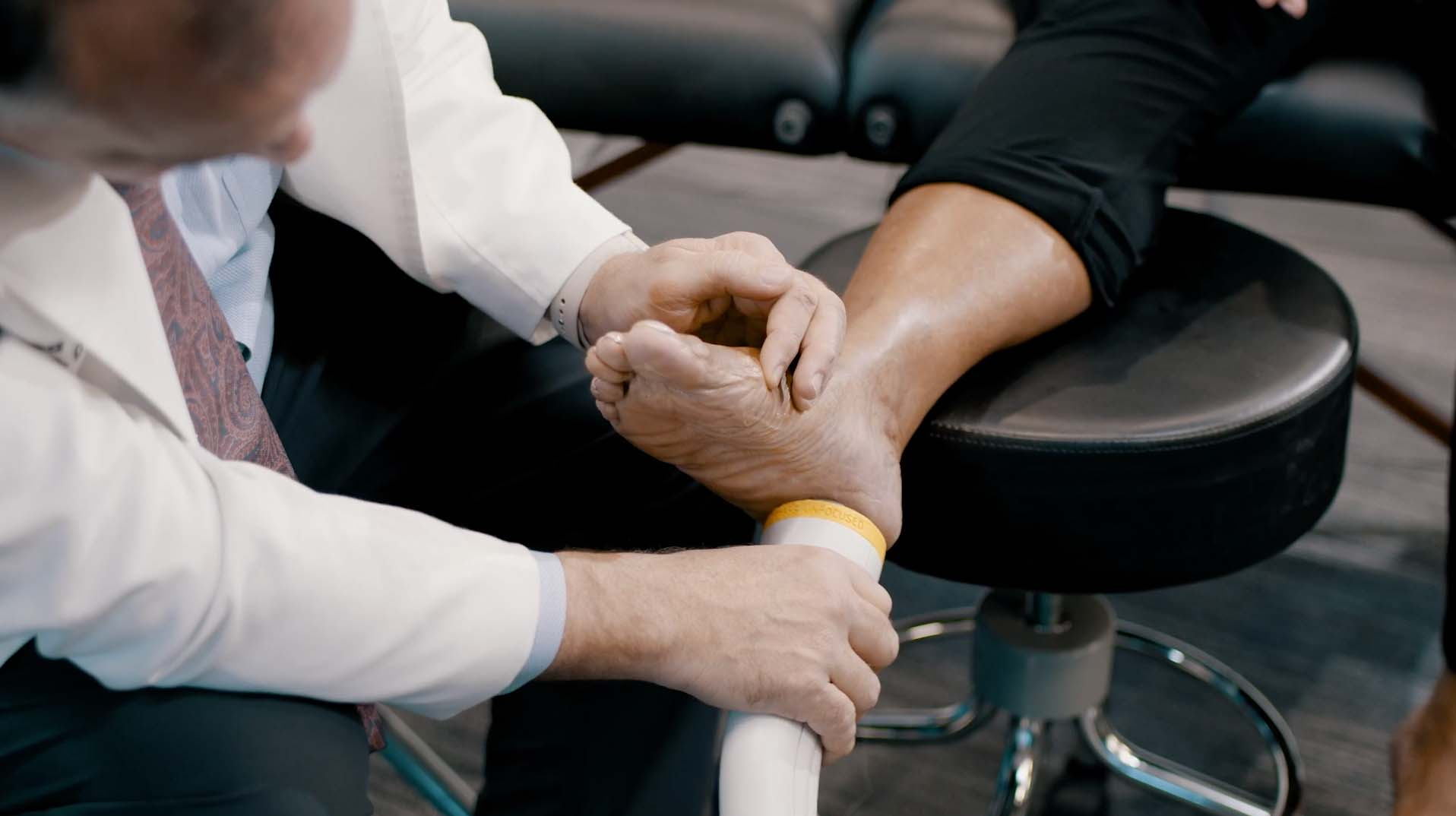
SoftWave therapy offers podiatrists a broad-focused electrohydraulic shockwave platform designed for wide, deep tissue coverage in clinical settings. Instead of limiting treatment to a narrow focal point, SoftWave delivers true shockwaves across a broader treatment zone, supporting both superficial and deeper tissue involvement within one workflow.
This can be especially useful in podiatric care because many foot and ankle presentations involve more than one tissue layer. Chronic plantar fasciitis may involve fascia, insertional pain, surrounding soft tissue irritation, and compensatory gait changes. Diabetic foot cases may involve wound tissue, impaired perfusion, neuropathic symptoms, and chronic inflammation. A broad-focused treatment field gives podiatrists a practical way to address larger treatment areas while maintaining clinical efficiency.
SoftWave is positioned for podiatric use cases such as plantar fasciitis, Achilles tendinopathy, diabetic foot ulcers, chronic wounds, heel spur symptoms, Morton neuroma symptoms, peripheral neuropathy symptoms, and bunion pain. SoftWave’s FDA clearances include activation of connective tissue, temporary increase in local blood circulation, temporary pain relief, treatment of chronic diabetic foot ulcers, and treatment of acute second-degree burns.
Advancing Your Practice with SoftWave
Shockwave therapy continues to gain relevance in podiatric medicine as providers look for non-invasive options that support musculoskeletal care, wound care, and regenerative treatment models. For practices focused on expanding clinical capabilities while maintaining efficient treatment delivery, SoftWave offers a broad-focused approach designed for modern foot and ankle care.
SoftWave is a clinical technology for providers, not an at-home consumer device. Podiatrists and clinical practices interested in adding SoftWave can Become a Provider or Schedule a Demo.