Chronic wounds continue to present a persistent clinical challenge across wound care, podiatry, plastic surgery, and regenerative medicine practices. Diabetic foot ulcers, venous leg ulcers, and partial-thickness burns often fail to progress through normal healing phases due to impaired microcirculation, sustained inflammation, and reduced cellular signaling within the tissue environment. Standard wound care remains foundational for infection control, debridement, and pressure offloading, but these measures do not directly address the biologic stagnation that prevents many wounds from advancing beyond the inflammatory phase, which is where extracorporeal shockwave therapy (ESWT) or shockwave therapy for wound care enters the picture.
Why Chronic Wounds Stop Healing
Normal wound healing moves through four sequential phases: hemostasis, inflammation, proliferation, and remodeling. In chronic wounds, healing stalls at the inflammatory phase. The wound environment becomes dominated by elevated matrix metalloproteinases, persistently activated inflammatory mediators, and reduced growth factor availability. Tissue perfusion is impaired, cellular signaling is suppressed, and the proliferative activity needed to form granulation tissue and drive re-epithelialization cannot gain traction.
Standard wound care addresses surface conditions well. Debridement removes nonviable tissue, compression manages venous insufficiency, and antimicrobial dressings control bacterial burden. What these approaches cannot do is restore the biological activity of the wound microenvironment. Regenerative technologies are increasingly applied in clinical wound care precisely because they address this gap, targeting the cellular and vascular dysfunction that keeps chronic wounds stalled.
How Shockwave Therapy Supports Wound Healing
A shockwave is a high-amplitude, supersonic pressure pulse with a rapid rise time and a single-cycle waveform. When applied to tissue through an extracorporeal device, it exerts mechanical force on cells and extracellular matrix structures, initiating a cascade of biological responses through mechanotransduction: the conversion of mechanical stimuli into intracellular signaling activity that influences gene expression, protein synthesis, and cellular behavior.
Several mechanisms are relevant to wound care. Shockwave exposure has been associated with increased expression of vascular endothelial growth factor (VEGF), which promotes angiogenesis and improves microcirculation in ischemic or poorly perfused tissue, a key pathway in wounds where vascular insufficiency is a driving factor. Progenitor cell recruitment and growth factor release contribute to the proliferative activity needed to form granulation tissue and advance toward remodeling. Chronic wounds also frequently remain locked in a pro-inflammatory state, and ESWT has been shown to modulate macrophage activity in ways that support progression toward a pro-healing phenotype, shifting the wound environment from chronic inflammation toward active repair (Omar et al., 2017).
Unlike topical or passive therapies, ESWT interacts directly with the tissue microenvironment. It activates wound beds, wound margins, and the surrounding periwound tissue simultaneously, which is particularly relevant in larger or irregularly shaped wounds where healing requires activity across a broad area rather than at a single focal point.
What the Evidence Shows for ESWT in Wound Care
The clinical literature on shockwave therapy in wound care spans device-specific randomized trials, condition-specific systematic reviews, and meta-analyses. A few studies illustrate the range of evidence and the wound types where it is most established:
- Skin graft donor site healing. A prospective randomized trial using the DermaGold device (Tissue Regeneration Technologies, now SoftWave Gold Li Series) applied a single shockwave treatment to donor sites immediately after skin harvest in patients with acute traumatic wounds and burns. The ESWT group achieved complete epithelialization in a mean of 13.9 days versus 16.7 days in the control group (p=0.0001), a statistically significant acceleration from a single treatment session (Ottomann et al., 2010).
- Second-degree burn re-epithelialization. A prospective randomized phase II trial using the same DermaGold platform evaluated ESWT versus standard therapy in 50 patients with superficial second-degree burn wounds. Patients receiving shockwave therapy achieved complete re-epithelialization significantly faster than those receiving standard care alone, supporting ESWT as a clinically meaningful adjunct in acute burn wound management (Ottomann et al., 2012).
- Non-healing venous leg ulcers. A case series of patients with chronic venous leg ulcers open for more than a year found that 13 weekly ESWT sessions resulted in complete wound closure in both cases, with no adverse effects reported during 10 to 15 minute outpatient sessions. While preliminary, the findings suggest that ESWT may support healing progression in VLUs resistant to standard care (Regulski, 2023).
- Diabetic foot ulcer healing. A systematic review and meta-analysis of randomized controlled trials found that ESWT significantly improved healing outcomes in patients with diabetic foot ulcers across multiple wound area metrics and re-epithelialization measures, supporting its use as an adjuvant alongside standard diabetic foot care (Huang et al., 2020).
- Chronic lower extremity wounds. A systematic review of 11 studies involving 925 patients evaluated ESWT across chronic wounds of the lower extremity, including venous, arterial, and diabetic etiologies. Authors concluded there was mild to moderate evidence supporting ESWT as an adjuvant therapy when combined with a standardized wound care program (Omar et al., 2017).
Across these sources, the wound types where clinical evidence is most developed are diabetic foot ulcers, venous leg ulcers, partial-thickness burns, and chronic non-healing wounds that have failed standard conservative care.
SoftWave Shockwave Therapy for Wound Care
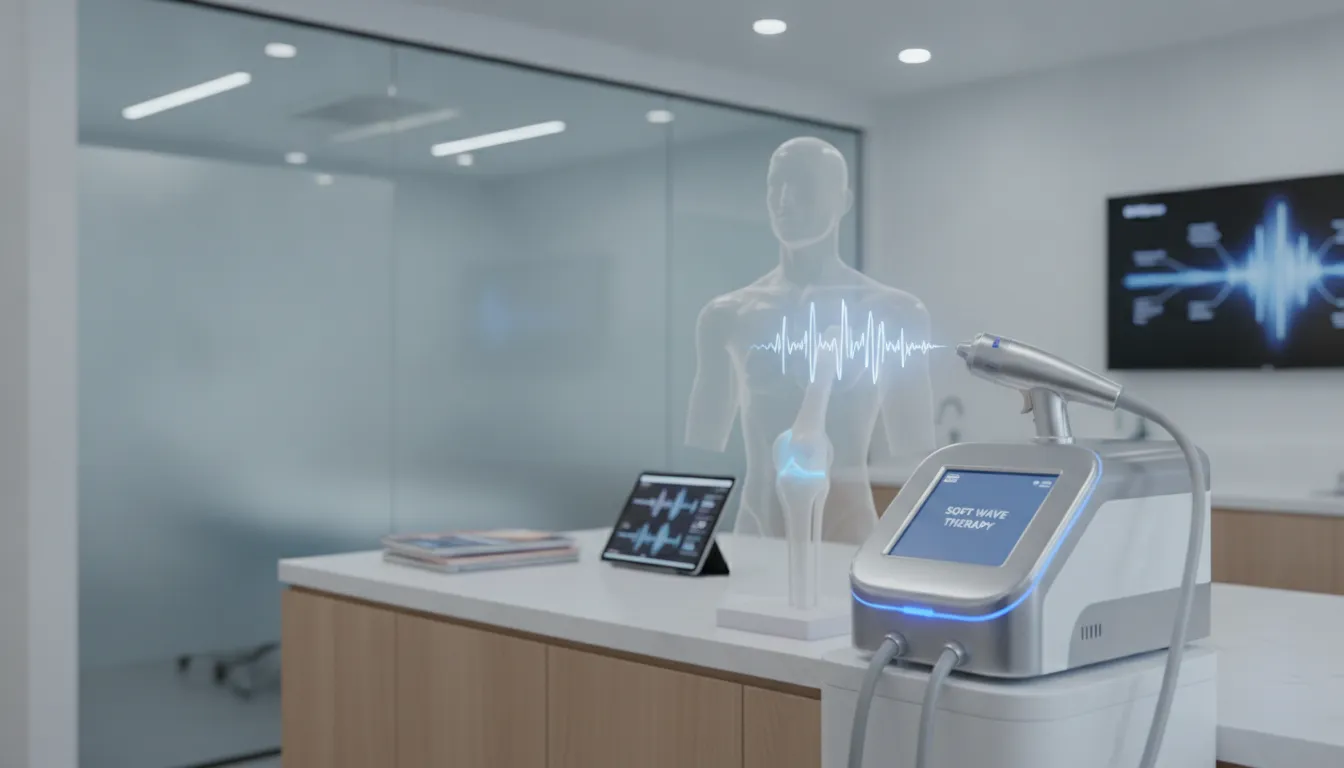
Among shockwave systems, SoftWave is the only broad-focused electrohydraulic device on the market and the direct successor to the DermaGold platform used in the Ottomann trials above. Its patented parabolic reflector distributes plasma-driven shockwaves across a wider and deeper treatment field than focused or radial systems, which is particularly relevant in wound care where the wound bed, wound margins, and surrounding periwound tissue all need to be addressed, not just a single focal point.
Several features speak specifically to the wound care context:
- FDA Class II clearances for wound indications. SoftWave holds FDA Class II clearances for the treatment of chronic diabetic foot ulcers and treatment of second-degree burns, the two highest-volume wound care indications in clinical practice. These clearances reflect device-specific regulatory review of safety and effectiveness, not category-level registration.
- Anabolic energy delivery. Energy is delivered at or below 0.18 mJ/mm², within the regenerative range that promotes healing without the cellular damage associated with energy levels above 0.22 mJ/mm².
- Broad coverage per pulse. The wide treatment field allows simultaneous stimulation of the wound bed, margins, and periwound tissue in a single pass, reducing treatment time and ensuring the periwound vasculature that supports healing is addressed alongside the wound itself.
- ISMST recognition. The device is recognized by the International Society for Medical Shockwave Treatment, consistent with the evidence base reviewed in the clinical literature.
Clinical precautions. Shockwave therapy should not be applied directly over areas of deep or uncontrolled infection, and caution is appropriate in patients on anticoagulant therapy. Treatment is not indicated where a fetus may be within the treatment field. As with most regenerative modalities, outcomes are optimized when ESWT is used alongside, not instead of, standard wound care protocols.
Most SoftWave sessions run 10 to 15 minutes with no anesthesia or surgical preparation required, fitting within standard outpatient wound clinic workflows.
READ: The Best Shockwave Therapy Machine for Providers
Advancing Regenerative Wound Care With Shockwave Therapy
Chronic wounds and burn injuries share a common problem: the biology of healing has stalled, and surface-level interventions alone cannot restart it. The growing clinical evidence base for ESWT, including device-specific trials conducted with the DermaGold platform and broader systematic reviews of chronic lower extremity wounds, supports shockwave therapy as a modality that actively engages the wound microenvironment rather than managing its surface. For clinicians working in wound care, podiatry, plastic surgery, or regenerative medicine, the question is not whether shockwave belongs in the wound care toolkit, but which device delivers the depth, treatment volume, and regulatory standing to support that work.
SoftWave’s broad-focused electrohydraulic delivery, multiple FDA Class II wound care clearances, and direct lineage from the DermaGold research platform make it the system to evaluate when adding regenerative shockwave therapy to a wound care practice. The biology it activates (angiogenesis, progenitor cell recruitment, inflammation modulation) is precisely what stalled wounds need to move forward.
Become a Provider or Schedule a Demo to explore how SoftWave integrates into your wound care practice.