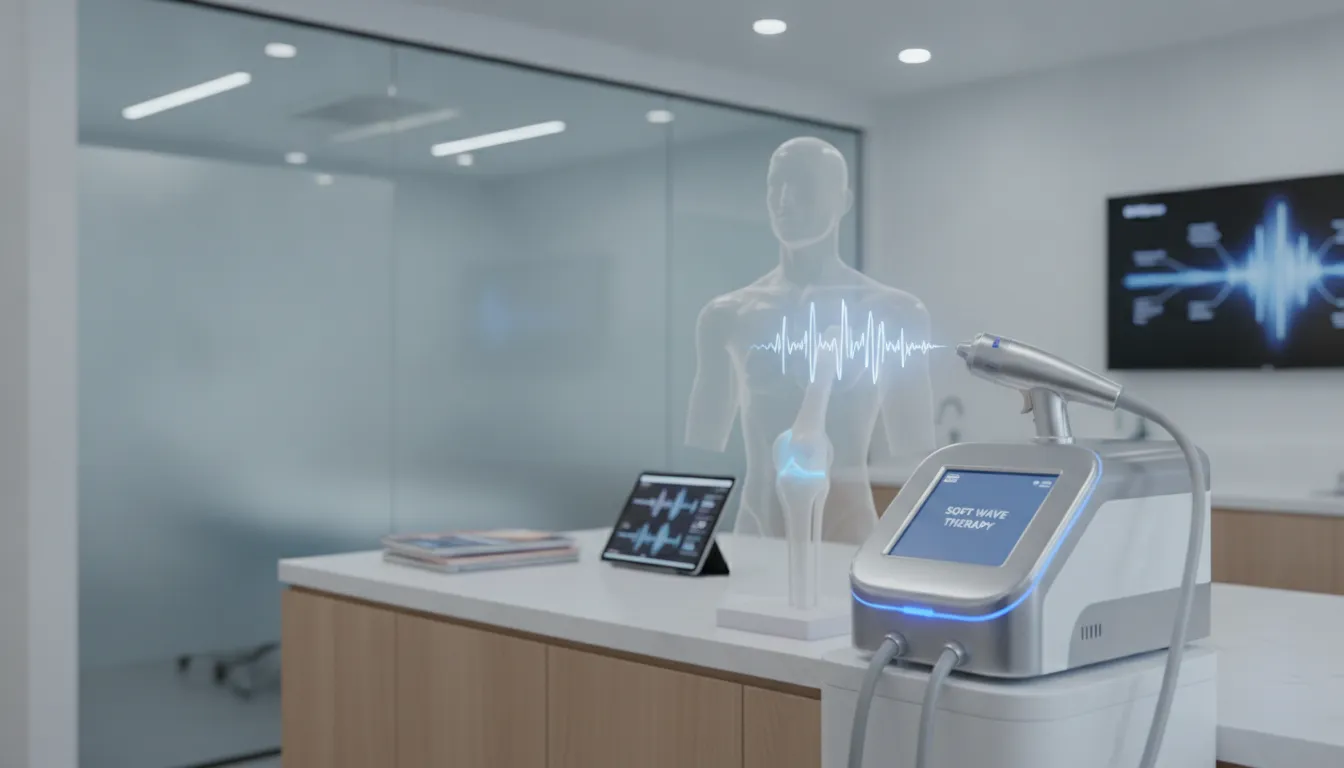
Shockwave therapy has become an established modality in musculoskeletal care, regenerative medicine, and pain management. As providers evaluate which technology fits their clinical workflow, one of the most common comparison questions involves piezoelectric versus electrohydraulic shockwave systems.
Both fall under extracorporeal shockwave therapy (ESWT) and deliver therapeutic acoustic energy designed to stimulate healing, reduce pain, and improve function. The way each device generates that energy and delivers it into tissue, however, produces meaningfully different clinical profiles. The sections below cover the mechanism, the comparison, the indications each is best suited for, and where the technology fits across provider workflows.
What Is Piezoelectric Shockwave Therapy and How Does It Work?
Piezoelectric shockwave systems generate focused acoustic waves using an array of piezoelectric crystals arranged in a concave transducer. When an electrical current is applied, the crystals rapidly expand and contract along their axes, creating pressure pulses that converge at a focal point inside the tissue. Because the energy self-focuses through the geometry of the therapy source itself rather than relying on an external reflector, piezoelectric systems are engineered for highly localized energy delivery.
Penetration depth is typically controlled using interchangeable gel pads of different thicknesses, with most systems delivering treatment in the 0–6 cm range depending on the therapy source and configuration. The focal zone itself stays compact even when intensity settings change, which is part of what makes piezoelectric devices well-suited to clearly defined pathology. Modern platforms also offer multiple therapy source options including point-focused, linear-focused, and planar energy delivery, allowing providers to adjust treatment volume based on the indication.
How Electrohydraulic Shockwave Therapy Differs
Electrohydraulic systems take a different generation approach. An electrical spark within a fluid medium rapidly vaporizes the surrounding water, producing a gas bubble whose expansion and implosion generates a true shockwave. That shockwave is then directed into tissue using a reflector, with the reflector geometry determining whether the resulting energy is focused at a narrow point or distributed across a wider treatment field.
This distinction matters clinically. Focused electrohydraulic devices concentrate energy at a single focal point in a manner conceptually similar to piezoelectric systems, while broad-focused electrohydraulic systems use a parabolic reflector to spread energy across a larger and deeper tissue volume per pulse. Treatment depth across electrohydraulic systems can reach up to 12 cm depending on device design. The broad-focused variant is the foundation of the SoftWave TRT platform and represents a distinct clinical category from focused electrohydraulic, electromagnetic, or piezoelectric devices.
Piezoelectric vs Electrohydraulic Shockwave: Key Clinical Differences
Both technologies deliver acoustic energy capable of stimulating biologic repair, but the practical differences shape which clinical scenarios each device fits.
| Feature | Piezoelectric Shockwave | Electrohydraulic Shockwave |
|---|---|---|
| Energy generation | Piezo crystals (electrical to mechanical) | Spark in fluid (spark-gap, electrohydraulic principle) |
| Focal zone | Narrow, self-focused via crystal geometry | Variable: narrow (focused) or wide (broad-focused) |
| Treatment depth | Typically 0–6 cm, gel pad-adjustable | Up to 12 cm depending on device |
| Treatment field | Compact, holds shape across intensity settings | Compact or wide, depending on reflector design |
| Patient tolerance | Higher peak pressure at focal point may cause more discomfort at high intensity | Broader dispersion generally well tolerated; focal designs comparable to piezoelectric |
| Best fit | Discrete, well-localized pathology | Localized or multi-layer presentations, depending on focus type |
A systematic review by Schmitz et al., 2015 of focused ESWT studies in the PEDro database compared outcomes across electrohydraulic, electromagnetic, and piezoelectric generators and found no scientific evidence favoring one generation principle over another at the category level. A review by Porst, 2021 covering six marketed ESWT devices used in low-intensity sexual medicine applications reached a similar conclusion: positive results were reported across all three energy types (electrohydraulic, electromagnetic, piezoelectric), but with substantial differences in energy flux densities, treatment protocols, and total applied energies between devices.
What separates outcomes in practice is the match between device profile (focal zone size, depth, energy distribution, total applied energy) and the clinical presentation being treated, not the underlying generation mechanism itself. Device selection should be driven by indication fit rather than a presumption that one technology category outperforms another in absolute terms.
Clinical Indications for Piezoelectric and Electrohydraulic Shockwave Therapy
The literature supports both technologies across overlapping musculoskeletal indications, with device-specific evidence helping clarify where each profile fits in practice.
Piezoelectric indications
Piezoelectric systems are most often applied to clearly localized pathology where precise energy placement is essential. Common applications include chronic tendinopathies (Achilles, lateral epicondylitis), calcific shoulder tendinopathy, plantar fascia pain with a defined insertional pain point, and trigger point therapy for persistent myofascial pain. A retrospective study of 90 patients by Vaamonde-Lorenzo et al., 2019 using the PiezoWave F10 G4 generator reported statistically significant pain improvement in plantar fasciitis maintained at six months post-treatment. A randomized placebo-controlled pilot study by Gesslbauer et al., 2021 found focused piezoelectric ESWT produced significant improvement in pain, grip strength, and electrodiagnostic measurements in mild-to-moderate carpal tunnel syndrome compared with sham at 12 weeks.
Electrohydraulic indications
Electrohydraulic systems span a wider clinical range because the category includes both focused and broad-focused designs. Focused electrohydraulic devices address localized tendinopathy and calcific pathology, while broad-focused electrohydraulic platforms extend into multi-layer musculoskeletal presentations, vascular and circulatory applications, and chronic wound care, with FDA Class II clearances including chronic diabetic foot ulcers and second-degree burns. A study by Kalika and Bubnov, 2022 using the OrthoGold 100 (SoftWave TRT) alongside the Storz Duolith SD1 Ultra found ultrasound-guided focused, defocused, and radial ESWT produced significant pain reduction in chronic low back pain, with the broad-focused (defocused) mode well-suited to back muscle pathology. A chart review by Goldstein and Goldstein, 2024 of 189 women treated with the SoftWave Urogold 100 reported PGI-I improvement rates of 54-83% across multiple sexual dysfunction indications, with no significant adverse events.
The distinction in practice is less about which condition each device can treat and more about how efficiently it covers the presentation: focal devices for discrete targets, broad-focused for larger or multi-layer regions.
Where SoftWave’s Broad-Focused Electrohydraulic Platform Fits
Within the electrohydraulic category, SoftWave operates as a broad-focused platform built around a patented parabolic reflector that distributes acoustic energy across a treatment zone approximately 7 cm wide and up to 12 cm deep. SoftWave’s Gold Li Series device’s architecture engages superficial and deeper tissue layers in a single application pass, eliminating the repositioning required with narrower focal devices.
SoftWave holds multiple FDA Class II clearances for indications including activation of connective tissue, chronic diabetic foot ulcers, superficial second-degree burns, and increased local blood circulation. The platform supports clinical use across orthopedics, sports medicine, podiatry, physical therapy, urology, and regenerative medicine.
Choosing the Right Shockwave Therapy for Your Practice
The right shockwave technology depends on the clinical presentations driving your patient volume and the operational realities of your practice. Focal zone size, treatment depth, energy distribution, and the strength of supporting evidence shape both clinical outcomes and how the platform integrates into a regenerative service line. Piezoelectric and focused electrohydraulic systems fit discrete, well-localized pathology; broad-focused electrohydraulic systems extend into multi-layer presentations, larger anatomical regions, and wound care indications.
SoftWave TRT addresses that broader scope through clinical adoption few competitors match: more than two decades of clinical use, over 240 peer-reviewed studies supporting the underlying technology, and active use at Mayo Clinic, Cleveland Clinic, HSS, and team medical staffs across the NFL, NBA, MLB, and PGA. Treatment protocols are shorter, sessions per patient fewer, and per-treatment labor cost lower than focused or radial alternatives, supported by structured on-site onboarding and ongoing clinical education. Become a SoftWave Provider or schedule a demo to evaluate fit for your patient mix and practice goals.