Non-healing wounds are among the most resource-intensive challenges in clinical practice. They drive repeat visits, increase complication risk, and represent a significant cost burden across the healthcare system.
Extracorporeal shockwave therapy (ESWT) has gained meaningful clinical traction as a non-invasive option that can accelerate wound closure across a wide range of wound types. The acute versus chronic distinction has direct clinical implications for what providers can expect from treatment, and where ESWT delivers the strongest return. The distinction is worth building into clinical decision-making for wound care, podiatry, orthopedics, and rehabilitation practices.
How Acute and Chronic Wounds Differ Clinically
The clinical difference between acute and chronic wounds is fundamentally a biologic one, and it shapes how any regenerative modality performs.
Acute wounds are recent injuries: post-surgical dehiscence, traumatic soft tissue defects, second-degree burns, and open wounds resulting from direct trauma. The tissue biology in these presentations is generally intact. The inflammatory cascade has been activated, perfusion remains present, and the conditions for healing exist. The wound needs support in progressing through the normal repair cycle rather than restoration of a failed one.
Chronic wounds are biologically different. Diabetic foot ulcers, venous stasis ulcers, arterial insufficiency ulcers, and long-standing pressure injuries typically have failed one or more standard interventions before reaching a wound specialist. The healing cascade may be stalled or dysfunctional, the local tissue environment is often compromised by ischemia or prior infection, and many of these wounds have been present for months by the time advanced therapy is considered. The result is a wound environment where the normal repair signals are either suppressed or actively counterproductive.
That distinction matters when evaluating any advanced wound care modality. ESWT is not simply addressing surface-level tissue. It is influencing the underlying biologic environment responsible for repair.
How Shockwave Therapy Acts on Wound Tissue
The mechanism is mechanotransduction. When acoustic shockwaves pass through soft tissue, they convert physical energy into biochemical signaling at the cellular level, triggering biologic responses that actively support repair and regeneration.
The most clinically significant effect for wound applications is angiogenesis. ESWT stimulates upregulation of VEGF and other angiogenic mediators, supporting new microvascular formation in tissue that may be perfusion-limited. The mechanism has been characterized at the cellular level: shockwave-induced ATP release activates purinergic receptors, which in turn drive Erk1/2 signaling and enhanced cell proliferation in both in vitro and in vivo wound models (Weihs et al., 2014). The clinical implication is that ESWT acts as an active biologic stimulus rather than a passive treatment, which is consistent with broader regenerative medicine evidence on mechanical signaling in chronic wound healing (Abdelhakim & Ogawa, 2025).
Alongside angiogenesis, ESWT modulates the chronic inflammatory environment that defines most non-healing wounds. Chronic wounds often remain locked in a prolonged inflammatory phase, delaying the transition into active tissue repair. Shockwave therapy helps regulate inflammatory signaling and supports progression into the proliferative phase, with associated effects on extracellular matrix remodeling and improved epithelial quality. Emerging mechanistic evidence in burn scar models has further characterized how ESWT influences immune activation and tissue remodeling in chronic injury (Jin et al., 2025).
Another challenge in chronic wound management is the presence of bacterial biofilms. Biofilms are organized communities of microorganisms embedded within a protective extracellular matrix that can make bacteria more resistant to both immune defenses and antimicrobial therapies. Their presence has been associated with delayed healing and persistence of chronic wounds. Emerging research suggests that shockwave therapy may help disrupt biofilm architecture and improve the wound microenvironment, although additional research is needed to fully define these effects across different wound types.
These effects represent active biologic stimulation rather than temporary symptomatic management (Chen & Suputtitada, 2025). Shockwave therapy is increasingly integrated alongside standard wound care protocols rather than treated as a competing intervention.
What the Evidence Shows for Acute and Chronic Wounds
The strongest body of evidence supporting ESWT for wound healing comes from surgical, wound care, and rehabilitation literature spanning two decades of clinical use.
Acute wounds consistently respond faster and more completely than chronic wounds, which aligns with the underlying biology. When local perfusion remains intact and tissue has not entered a failed healing cycle, ESWT appears to accelerate progression toward closure rather than first needing to reverse a dysfunctional environment. A foundational prospective study by Schaden et al., 2007 enrolled 208 patients with acute and chronic soft tissue wounds, including post-surgical wounds, burns, and traumatic injuries. Complete epithelialization was achieved in 75% of patients, with the strongest response observed in acute wound presentations. No treatment-related toxicity, infection, or wound deterioration was reported across the cohort.
Chronic wounds present a more difficult biologic problem, and the evidence reflects that honestly. Healing rates are generally lower, treatment timelines may be longer, and outcomes vary depending on wound etiology and vascular status. Even so, ESWT has demonstrated meaningful clinical utility in chronic wound populations. A prospective study by Jeong et al., 2023 showed that ESWT significantly improved microcirculation (measured by transcutaneous partial oxygen pressure) in patients with Wagner grade I and II diabetic foot ulcers, with measurable improvement after at least two weeks of treatment or six sessions.
At the systematic review level, a 2023 updated review in the International Wound Journal analyzed six trials with 471 participants and concluded that time to ulcer healing was shorter with ESWT plus standard care than with standard care alone in chronic DFUs, with greater likelihood of complete healing at 20 weeks (Hitchman et al., 2023).
The comparison that matters clinically is not whether chronic wounds heal as rapidly as acute wounds. It is whether ESWT improves outcomes compared with what providers are currently achieving using standard wound care alone in difficult-to-heal patients. Across multiple studies, the answer is increasingly favorable.
What Predicts Treatment Response in Wound Care
Three variables consistently emerge as independent predictors of ESWT response in wound healing, derived from the largest prospective wound-healing analysis to date (Schaden et al., 2007):
- Wound duration. The strongest predictor of response. Wounds present for one month or less responded significantly better than longer-standing wounds (OR 0.25; 95% CI, 0.11 to 0.55). Earlier intervention produces substantially better outcomes.
- Wound size. Wounds measuring 10 cm² or less healed more reliably than larger wounds (OR 0.36; 95% CI, 0.16 to 0.80). Larger surface areas are associated with increased risk of incomplete healing.
- Patient age. Younger patients showed stronger regenerative response, consistent with the general biology of tissue repair in older populations with vascular or metabolic comorbidities.
Notably, diabetes itself did not independently predict treatment failure in this analysis, which is clinically relevant for podiatric and diabetic wound care providers managing complex DFU patients.
Why Broad-Focused Shockwave Matters for Wound Indications
Not all shockwave platforms function the same way clinically, and device architecture becomes particularly important in wound care, where treatment coverage, tissue depth, and patient comfort directly affect workflow and outcomes.
Wound beds are often irregular in shape, distributed across multiple tissue depths, and larger than a single focal treatment zone. Narrow-focus devices may require repeated repositioning to treat the entire wound surface consistently. Broad-focused systems are designed to improve treatment coverage and reduce session complexity.
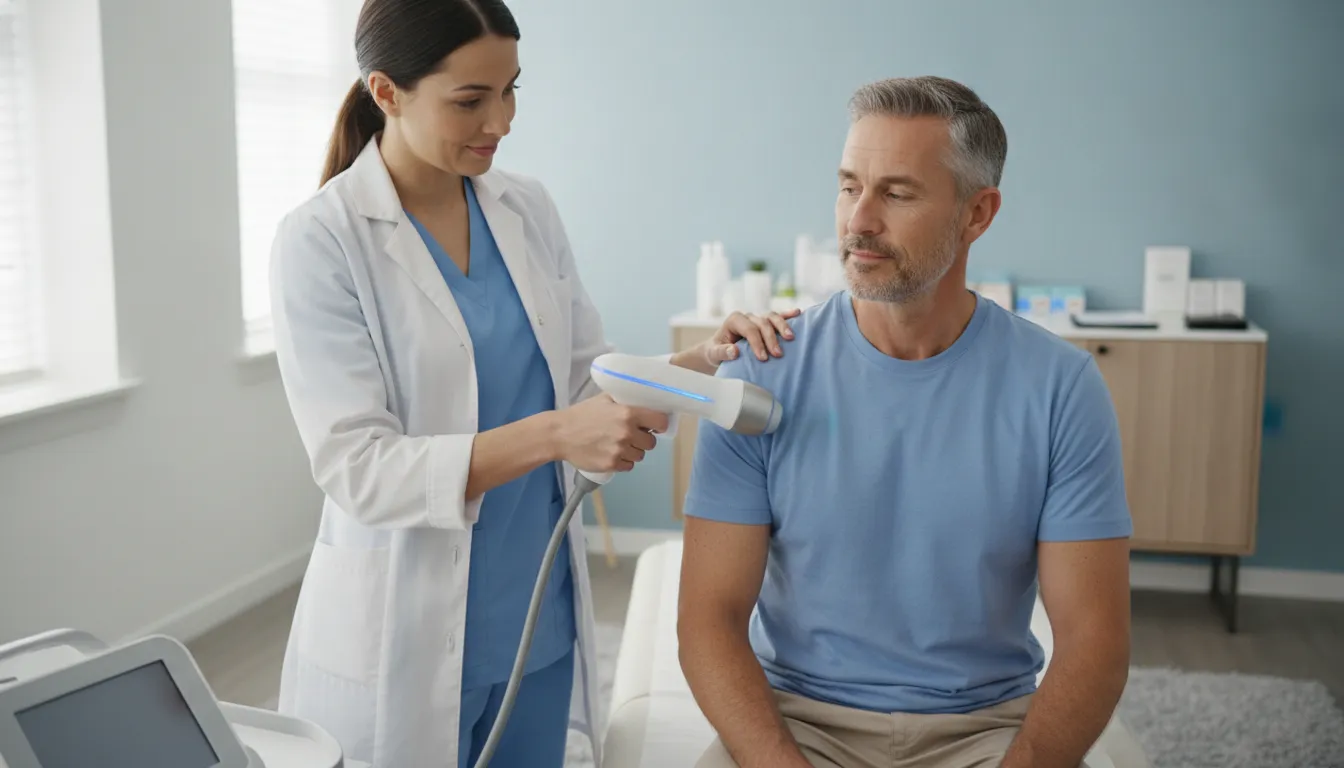
SoftWave Gold Li Series uses electrohydraulic technology with a patented parabolic reflector that generates a broad-focused acoustic field designed to reach both superficial and deeper tissue layers.. The treatment zone reaches approximately 7 cm wide and up to 12 cm deep, reducing the need for repeated applicator repositioning compared with narrow-focus treatment fields. Energy is delivered at low-intensity levels commonly used for regenerative applications. These energy settings are intended to stimulate biologic repair processes without intentionally creating tissue disruption or microtrauma.
SoftWave is FDA-cleared for chronic diabetic foot ulcers and superficial partial-thickness second-degree burns, and operates within standard outpatient workflows. Treatment sessions typically take under 15 minutes and may be administered by appropriately trained personnel in accordance with state scope-of-practice requirements and clinic protocols, and require no anesthesia. Full clearance documentation is available on the FDA Safety Page.
Integrating Shockwave Therapy into Wound Care Protocols
ESWT is not a replacement for standard wound care. In practice, it functions as an adjunctive regenerative modality used alongside appropriate debridement, dressing protocols, vascular management, offloading strategies, and systemic interventions.
For providers in wound care, podiatry, and regenerative medicine, the integration question is usually about timing and sequencing. Shockwave therapy fits naturally into protocols for wounds that have plateaued under conventional care, or as an early biologic intervention for acute wounds where accelerating closure is the goal. The outpatient, non-invasive nature of ESWT also reduces many of the logistical barriers associated with hyperbaric oxygen therapy or surgical wound reconstruction. Providers should follow the current SoftWave IFU for all contraindications, precautions, and treatment recommendations.
For practices managing complex wound presentations, irregular wound geometry, or stalled healing under standard care, broad-focused electrohydraulic shockwave offers a clinically grounded option with consistent delivery across both superficial and deeper tissue layers. SoftWave TRT’s wide-field energy distribution supports efficient treatment within a single session, which fits the workflow of multidisciplinary wound care environments without adding significant operational complexity.
Become a SoftWave Provider or schedule a demo to see how SoftWave TRT fits within your wound care workflow.