Shockwave therapy has expanded across sexual medicine and regenerative practice, yet device design differences still shape how energy is delivered into tissue. Platforms are often discussed as if they produce comparable biological effects, even when energy generation and treatment-field geometry vary in ways that can influence dosing, tolerance, and reproducibility.
Renova enters this landscape as a system marketed for linear shockwave treatment in men with erectile dysfunction. The peer-reviewed literature supporting the use of linear shockwave in ED provides useful clinical signals, though it does not always clarify how a specific device, such as Renova, performs in field size, depth distribution, or consistency across protocols. Framing Renova’s positioning within this wider context helps clinicians interpret available evidence with appropriate specificity and set expectations that match what is actually documented.
What Renova Shockwave Therapy Claims To Be
Renova is marketed as a low-intensity extracorporeal shockwave platform for erectile dysfunction care, with positioning that emphasizes vasculogenic presentations treated in office-based settings. Manufacturer materials describe a linear delivery concept intended to distribute energy along an extended segment rather than concentrating dosing into a single small focal point.
Only a few points about Renova can be stated with confidence.
- Published reports that name Renova are largely limited to erectile dysfunction and male sexual health, with some appearing as conference supplement reports rather than full manuscripts. Kurosawa et al., (2024).
- Linear LI ESWT research exists for erectile dysfunction using related systems from the same manufacturer group, though this does not validate every branded platform, like the Renova. Patel et al. (2020).
- Independent reporting of treatment field size and depth distribution is often limited in ED shockwave studies rather than specific to Renova, which can affect protocol transfer. Porst (2021).
- When field geometry is not reported, expectations are often drawn from broader LI ESWT evidence rather than device-level characterization.
Taken together, Renova is best understood as a linear LI ESWT platform marketed for ED, with published discussion and limited device-named reporting concentrated in sexual health rather than broader regenerative indications, and with incomplete public documentation of device-specific treatment field dimensions and depth distribution.
Where Linear Low Intensity Shockwave Has Evidence in the Literature
Linear low intensity extracorporeal shockwave therapy has been studied most often in vasculogenic erectile dysfunction, using protocols intended to deliver low-energy dosing across corporal targets over multiple sessions. Across randomized and sham-controlled studies, improvements are reported in some cohorts, but response varies depending on baseline severity, protocol parameters, and follow-up duration.
A few peer-reviewed examples show what this literature supports and where interpretation still requires caution:
- A randomized, double-blind, sham-controlled trial using a linear low-energy approach reported changes in erectile function outcomes, with variability across participants. Fojecki et al. (2017)
- A 12-month follow-up from the same trial framework adds context on durability and the proportion of men who maintain their response over time. Fojecki et al. (2018)
- A randomized clinical trial assessing energy flux density and session frequency supports the idea that dosing choices can affect outcomes, even within low-intensity protocols. Kalyvianakis et al. (2019)
- The author also reported that a Phase II randomized trial evaluating two treatment schedules with a linear device suggests treatment cadence is a meaningful variable in erectile dysfunction protocols.
- A systematic review and meta analysis across randomized trials reports overall improvements on average, while emphasizing heterogeneity in devices and protocols, which limits direct protocol transfer across different linear platforms. Yao et al. (2022)
Clinical considerations that are more directly supported across this linear LI ESWT literature include:
- The most reproducible improvements are reported in vasculogenic erectile dysfunction cohorts with mild to moderate baseline severity, while outcomes become more variable as baseline dysfunction severity increases or etiologies become mixed.
- Treatment response is protocol-sensitive, with energy flux density, pulse counts, treatment sites, and session cadence as active variables rather than interchangeable settings.
- Many published trials do not include independent device-level mapping of treatment field geometry and depth distribution, which limits confidence that a protocol can be transferred unchanged across different linear generators.
Read: Low Intensity Shockwave Therapy vs High Intensity: Which Works Best
Renova Shockwave Therapy in Clinical Context: What Is Missing
Renova is often evaluated as a linear, low-intensity shockwave option in ED care, yet several gaps limit how precisely clinicians can translate the broader LI ESWT literature into device-specific expectations.
1. Limited Device Named Clinical Literature
Publicly accessible clinical data for the device named Renova appear relatively limited. As a result, protocol expectations often rely on broader low-intensity shockwave evidence rather than Renova-specific performance data.
2. Incomplete Independent Output Characterization
Linear systems are commonly described using energy settings, pulses, and treatment sites. Independent documentation of measurable field geometry, depth distribution, and dose consistency along the linear segment is often not available in a way that supports confident protocol transfer.
3. Indication Concentration in Sexual Health
Renova is primarily positioned around male sexual health workflows. There is limited visibility of device-named studies using Renova, or of linear low-intensity protocols tied to Renova-type systems, across other specialties where shockwave platforms are often evaluated, such as orthopedics, wound care, and musculoskeletal rehabilitation.
4. Protocol Standardization Remains Challenging
Without clear device-level characterization and consistent reporting of dose delivery across the intended field, establishing standardized protocols and comparing outcomes across clinics can be difficult, even when treatment settings appear similar.
Taken together, these gaps suggest Renova should be interpreted within the current published scope, with cautious extrapolation beyond erectile dysfunction protocols.
Why Broad Focused Shockwave Design Is Increasingly Used in Clinical Practice
Regenerative presentations often involve layered tissue contributors rather than a single focal lesion. Broad-focused shockwave design delivers therapeutic energy across a larger field so treatment can cover a wider tissue environment during each application, reaching superficial structures and deeper targets within the same pass. This matters when symptoms extend across a region, anatomy is complex, or consistent coverage across tissue planes supports better protocol execution.
Clinical implications that follow from a broader field approach include:
- Larger area coverage per application, which can support protocols when pathology is diffuse or multifactorial
- Reduced dependence on pinpoint handpiece placement for every pulse sequence, which can support reproducibility across providers
- Practical efficiency when treating larger structures such as shoulders, hips, pelvic girdle, or longitudinal fascial regions
- Patient tolerance considerations, since energy distribution across a wider field can influence perceived intensity at any single point
- Clinical flexibility across specialties where presentations often involve multiple tissues, including orthopedics, sports medicine, rehabilitation, podiatry, urology, dermatology, and wound care
Taken together, these design considerations help explain why broad focused shockwave approaches are often selected when clinical goals involve regional tissue effects and consistent coverage across superficial and deeper structures, rather than dosing a single discrete target.
SoftWave Therapy as a Broad Focused Shockwave System With Multidisciplinary Validation
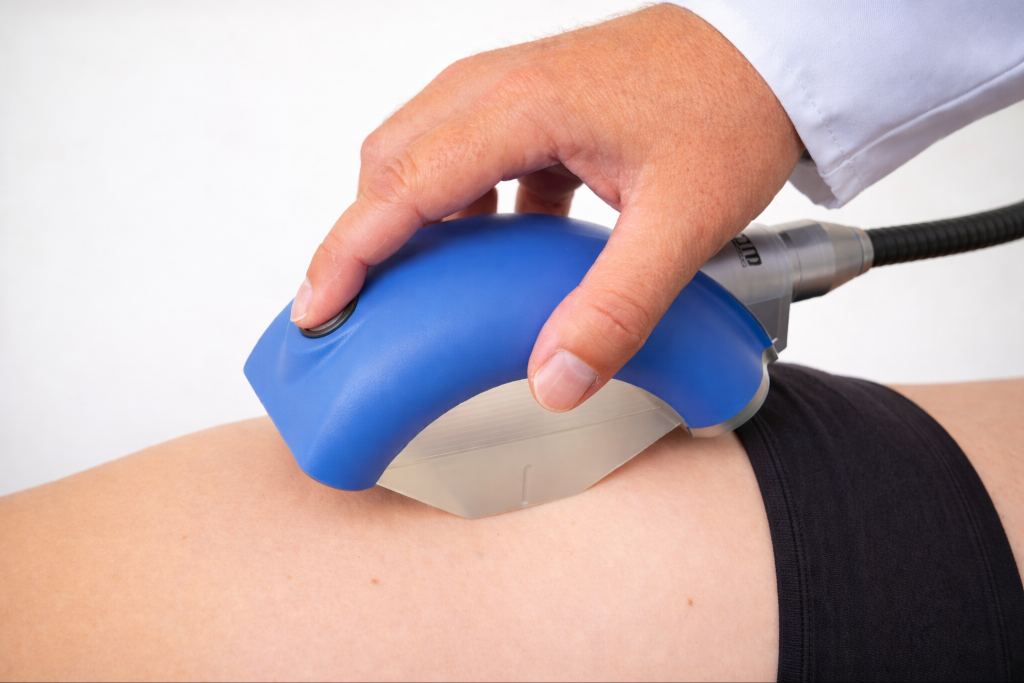
SoftWave Therapy is a patented, broad-focused shockwave system developed for in-office clinical use. It uses an electrohydraulic source with a patented parabolic reflector to deliver a broad therapeutic field that reaches superficial structures and deeper targets within the same application, supporting coverage of complex and layered anatomy relevant to regenerative care.
This broad focused field triggers biologic responses associated with tissue healing and remodeling, including modulation of inflammation, activation of connective tissue activity, and promotion of neovascularization. These effects are produced without concentrating dosing into a small focal point, supporting consistent patient tolerance across sessions.
SoftWave has received FDA 510(k) clearances that include:
- Activation of connective tissue
- Temporary increase in blood flow
- Temporary pain relief
- Treatment of chronic diabetic foot ulcers
- Treatment of acute second-degree burns
The system is designed exclusively for clinical use and has been integrated across specialties, including orthopedics, podiatry, sports medicine, physical therapy, urology, and wound care.
For clinicians, the practical distinction is coverage. Linear low intensity shockwave protocols deliver energy along a narrow corporal path, while SoftWave engages a wider surrounding tissue environment within a single application when regenerative planning extends beyond a single linear target.
How Clinicians Compare Shockwave Devices When Selecting a Platform
Clinicians often assess shockwave systems using practical criteria that shape treatment consistency, patient tolerance, and day-to-day workflow integration. This approach helps clarify how a platform aligns with musculoskeletal, regenerative, sexual health, or procedural service lines within a clinic.
Common criteria clinicians use include:
- Therapeutic field size and shape, including how much anatomy is covered per application
- Depth distribution and whether superficial and deeper structures are addressed within the same pass
- Patient tolerance at clinically relevant settings
- Regulatory clearances and how closely they match the clinic’s service lines
- Device named clinical evidence and the transparency of protocol reporting
- Operator dependence and how sensitive outcomes are to applicator placement and technique
- Multispecialty fit across orthopedic, sports medicine, rehab, podiatry, urology, dermatology, and wound care workflows
- Practical throughput factors such as treatment time, room utilization, and session cadence
These criteria support side-by-side evaluation of linear low-intensity platforms, such as Renova, used for ED, and broad-focused systems designed for wider regenerative coverage, helping clinicians match device architecture to the clinical presentations and practice demands they most often manage.
Choosing the Right Shockwave Platform for Clinical Use
Renova shockwave therapy fits within linear low-intensity shockwave protocols, with the most visible published evidence concentrated in erectile dysfunction and male sexual health. While this literature supports physiologic activity consistent with vascular-oriented mechanisms, variability in protocols and outcomes remains an important consideration when translating findings into standardized clinic workflows.
Broad-focused electrohydraulic systems such as SoftWave are designed to engage a larger tissue volume within a single application and hold FDA 510(k) clearances across multiple indications relevant to regenerative and wound care practice. When selecting a shockwave platform, clinicians commonly prioritize regulatory alignment, device-specific evidence quality, treatment field characteristics, patient tolerance, and workflow efficiency so the system matches the clinic’s patient population and service lines.
Learn more about the Best Shockwave Therapy Machine for Providers.
Integrate SoftWave Into Multidisciplinary Clinical Care
SoftWave is a patented, broad-focused, true shockwave system engineered for in-office care, delivering a wide therapeutic field that reaches superficial and deeper targets within the same application. Its FDA 510(k) clearances support integration into regenerative and wound care service lines.
Clinicians who want to assess clinical data and workflow fit can review published research, explore specialty-specific use cases, or schedule a guided demonstration.
Learn more about SoftWave clinical research.